
Mon–Sun: 12 AM–11:30 PM Serving Columbus since 1994

Tankless Water Heater Installation in Columbus

On-demand hot water, installed right the first time by Central Ohio's dual-trade plumbing team.
Tankless Water Heater Installation in Columbus

Get in touch

Call, text, or schedule online

★★★★
“Service person answered all my questions. I thought the estimate was a little to high. …”
Joseph P. · Google review

Columbus Tankless Water Heater Installation and Repair

Safe Electric & Plumbing handles tankless water heater installation in Columbus and throughout Central Ohio, and we've been doing it since 1994. If you're wondering whether the switch from a traditional tank is worth it for your home, the short answer is: often yes, but the details matter. Call (614) 267-4111 and one of our licensed plumbers will walk you through exactly what your house needs before any money changes hands.

Tankless units heat water on demand instead of keeping 40 to 50 gallons hot around the clock, which is where the energy savings come from. While the initial outlay for purchasing and installing a tankless system is higher than a standard tank, most Columbus homeowners see enough reduction in their monthly gas or electric bill that the unit pays for itself over time. What drives the total cost: whether you need a gas or electric model, the size of the unit relative to your household's peak demand, whether your existing gas line or electrical service needs upgrading, and the venting configuration your home requires. Columbus neighborhoods with older plumbing, from Clintonville bungalows to German Village row homes, sometimes need additional retrofit work that newer construction in New Albany or Powell does not. Every job is different, so contact Safe Electric & Plumbing for an accurate estimate.

What Happens During a Tankless Installation

A tankless water heater installation isn't a two-hour job if it's done correctly. Here's what the work actually involves.

  1. Assessment and Sizing

    We calculate your household's peak flow rate demand, showers, appliances, and fixtures running simultaneously, then match a unit to that load. An undersized unit delivers lukewarm water during morning rush. We won't let that happen.

  2. Gas Line, Electrical, and Venting

    High-efficiency tankless units pull more gas volume than a tank heater. We inspect your existing gas line and upgrade it if needed. For electric models, we verify your panel capacity. Venting routes must meet Ohio code: clearances from windows, property lines, and combustion air sources all apply.

  3. Installation and Permit Sign-Off

    We mount the unit, make all connections, test every safety control, and flush the system before we leave. Where local permits are required, we handle the paperwork. You get a working system and a documented installation, not a handshake and a hope.

Your Tankless System Is Telling You Something

Tankless water heaters are quieter than tanks but they're not silent when something's wrong. Banging or knocking sounds, fluctuations in water temperature, and low water pressure at the tap are all signs your system needs attention. The most telling sign: a sudden jump in your energy bills without a change in household habits. That usually means the unit is working harder than it should, often because of scale buildup from Columbus's mineral-heavy water. Navien units, which are common in Central Ohio, will display an error code on the digital panel when a fault occurs. Don't ignore those codes. A blocked condensate drain, a faulty igniter, or a failed flow sensor left alone long enough will take an easily repaired unit and turn it into a replacement. We stock common parts and can usually diagnose and repair on the first visit. For water treatment systems that reduce scale and protect your investment, we handle those installations too.
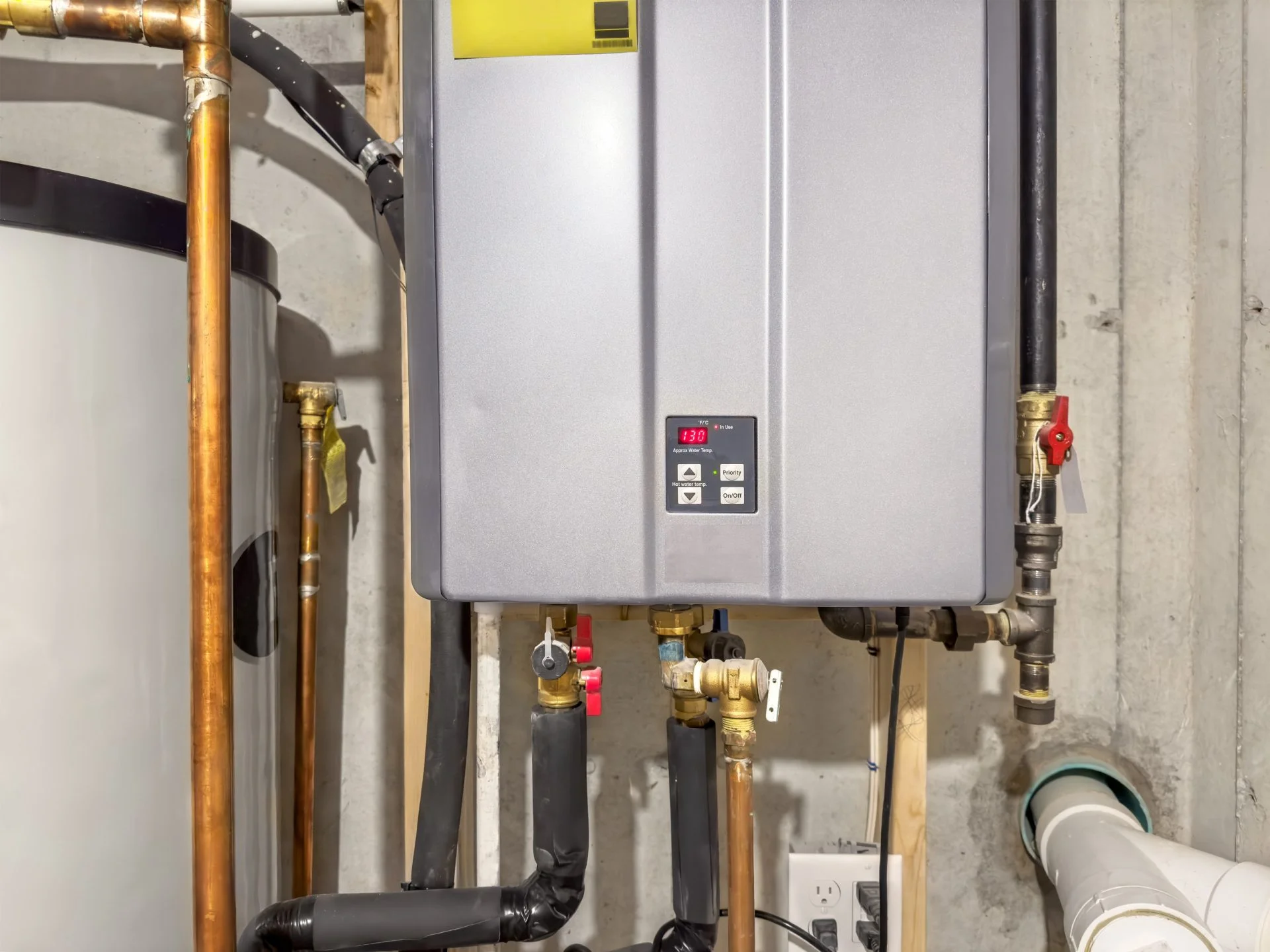
Tankless water heater installation with copper pipe connections, brass ball valves, and digital temperature display in a Columbus basement

Columbus Water Conditions and Your Tankless System

Columbus-area water carries enough dissolved minerals that scale buildup inside a tankless heat exchanger is a genuine maintenance concern, not a theoretical one. Annual descaling flushes the system with a diluted acidic solution that dissolves calcium deposits before they restrict flow or force the unit to work at higher temperatures. Skip that maintenance for a few years and you'll shorten the unit's lifespan significantly. For homeowners on well water in the outer Columbus suburbs, a water softener or treatment system upstream of the tankless unit is often the smarter long-term investment. Our plumbing team handles both the tankless installation and any water treatment work, so you're not coordinating between two separate contractors. If you're also weighing sewer drain health as part of a broader plumbing update, we can assess everything in one visit.

32 Years Installing and Repairing Plumbing in Central Ohio

Safe Electric & Plumbing has been the name Columbus homeowners call for plumbing work since Matt Wehrle opened the doors in 1994.

We're BBB accredited and have earned 4.9 stars across 2,962 Google reviews. The dual-trade capability matters on tankless jobs too: when the installation requires an electrical service adjustment alongside the plumbing work, one call handles both.
  1. In business since 1994

    32 years serving Columbus and Central Ohio

  2. 4.9 stars, 2,962 Google reviews

    BBB accredited

  3. Electrical and plumbing under one call

    No coordinating between separate contractors

Call (614) 267-4111

All the Plumbing Services We Handle

Tankless water heaters are one part of what Safe Electric & Plumbing covers for Columbus homeowners.

Our shop

3208 Morse Rd, Columbus, OH 43231

Mon–Sun: 12 AM–11:30 PM

Tankless Water Heater Questions

Not on the list?(614) 267-4111Mon–Sun: 12 AM–11:30 PM
What drives the cost of tankless water heater installation in Columbus?
The unit itself, the size required for your household's peak demand, whether your gas line needs upsizing, any electrical work tied to the installation, venting route complexity, and local permit fees all affect the total. Homes in older Columbus neighborhoods frequently need more retrofit work than newer construction. Every job is different, so contact Safe Electric & Plumbing for an accurate estimate.
What's the main downside of a tankless water heater?
Flow rate limits. A single tankless unit produces hot water continuously but only up to its rated gallons-per-minute capacity. If your household runs multiple high-demand fixtures simultaneously, an undersized unit will deliver lukewarm water. Correct sizing at installation prevents the problem. That's why we calculate peak demand before recommending a unit, not after.
How close can a tankless water heater exhaust vent be to a window?
Ohio code and manufacturer specs both set minimum clearances, typically 12 inches below and 12 inches to the side of any openable window, and at least 12 inches above any forced-air inlet. Exact distances depend on the unit's BTU rating and vent type. We route every installation to meet both the code requirement and the manufacturer's warranty terms.
Is there a federal tax credit for tankless water heaters in 2025 or 2026?
High-efficiency gas tankless units meeting the Energy Star UEF threshold of 0.95 or higher may qualify for a federal tax credit under current residential energy provisions. The credit amount and eligibility requirements can change annually. Confirm your specific unit qualifies with a tax advisor before filing. We can provide the unit's efficiency documentation for your records.
How often does a tankless water heater need maintenance in Columbus?
Annual descaling is the standard recommendation given Central Ohio water hardness. The flush removes calcium and mineral deposits from the heat exchanger before they restrict flow or force the unit to run hotter. Skipping maintenance for several years can cut the unit's lifespan in half. A maintenance visit is short, and far cheaper than a premature replacement.
Do I need a gas line upgrade or electrical work before installing a tankless unit?
Often yes. High-output gas tankless units require a larger gas supply line than most tank heaters. Electric whole-home tankless units draw enough amperage that panel capacity must be confirmed first, and sometimes an electrical service upgrade is needed. We assess both during the initial evaluation so there are no surprises on installation day.
How often does a tankless water heater need maintenance given Columbus water conditions?
Annual descaling is the standard recommendation given Central Ohio water hardness. The flush removes calcium and mineral deposits from the heat exchanger before they restrict flow or force the unit to run hotter. Skipping maintenance for several years can cut the unit's lifespan in half. A maintenance visit is short, and far cheaper than a premature replacement.
Do I need a gas line upgrade or electrical work before installing a tankless water heater?
Often yes. High-output gas tankless units require a larger gas supply line than most tank heaters. Electric whole-home tankless units draw enough amperage that panel capacity must be confirmed first, and sometimes an electrical service upgrade is needed. We assess both during the initial evaluation so there are no surprises on installation day.

Related