
Mon–Sun: 12 AM–11:30 PM Serving Columbus since 1994

Arc-Fault Breakers & Electrical Fire Prevention

Why the right breaker is the single most effective thing between your wiring and a house fire.
Arc-Fault Breakers & Electrical Fire Prevention

Get in touch

Call, text, or schedule online

★★★★★
“Bryce let me know exactly what was needed and informed me what he would do!”
Frank S. · Google review

How arc-faults start electrical fires

The National Fire Protection Association puts arc-faults at the origin of roughly 32% of all electrical fires, and the trouble starts inside the insulation wrapped around your wiring, not in the panel itself. By the time you smell smoke, the arc has already been burning for a while. Arc-fault circuit interrupters (AFCIs) are the one device designed to catch that problem before it reaches that point.

New homes in Ohio are already required by code to have AFCI breakers installed throughout. If your home predates that requirement, or if you've been running on a standard breaker panel for decades, your electrical panel may not have this protection. This article explains what arc-faults are, why standard breakers miss them, and what AFCI breakers actually do.

Matt Wehrle

Written by

Matt Wehrle · Owner, Safe Electric & Plumbing & Plumbing

What an arc-fault actually is

An arc-fault is a dangerous electrical problem caused by damaged, overheated, or stressed wiring or devices. It happens when electrical current jumps across a gap it was never meant to cross, generating intense heat that ignites nearby insulation, framing, or building materials. Arc-faults can occur when older wires become frayed or cracked, when a nail or screw damages a wire hidden inside a wall, or when an outlet or circuit has deteriorated over time. Because the arc is contained inside a wall cavity or behind an outlet box, it produces no tripped breaker, no burning smell at first, and no visible warning. Standard circuit breakers protect against overloads and short circuits, conditions that involve abnormal current draw. An arc-fault does not always draw excess current. That's the gap in protection that AFCI breakers fill.

Why standard breakers miss arc-faults

A standard breaker does one job. An AFCI breaker does three.

Overload protection

Standard breakers trip when a circuit draws more current than it's rated for, a space heater and a hair dryer on the same circuit, for example. Both AFCI and standard breakers handle this.

Short circuit protection

When a hot wire contacts a neutral or ground, current spikes sharply and a standard breaker trips. Again, both types handle this condition.

Inside an arc-fault circuit interrupter

An AFCI breaker is an electronic circuit breaker that sends test signals through the existing wiring and analyzes what comes back. Normal electrical loads, motors, dimmers, appliances, produce predictable waveforms. An arc produces a distinct, irregular signature. When the breaker's onboard processor detects that pattern, it trips the circuit instantly. This happens in milliseconds, well before enough heat accumulates to ignite insulation or framing. The technology was developed specifically because the NFPA found that a large share of electrical fires involved wiring that never drew enough current to trip a conventional breaker. AFCI protection closes that gap. If you're unsure what type of breakers your panel currently has, a qualified electrician can check during a standard electrical inspection.

The fire statistics behind the code requirement
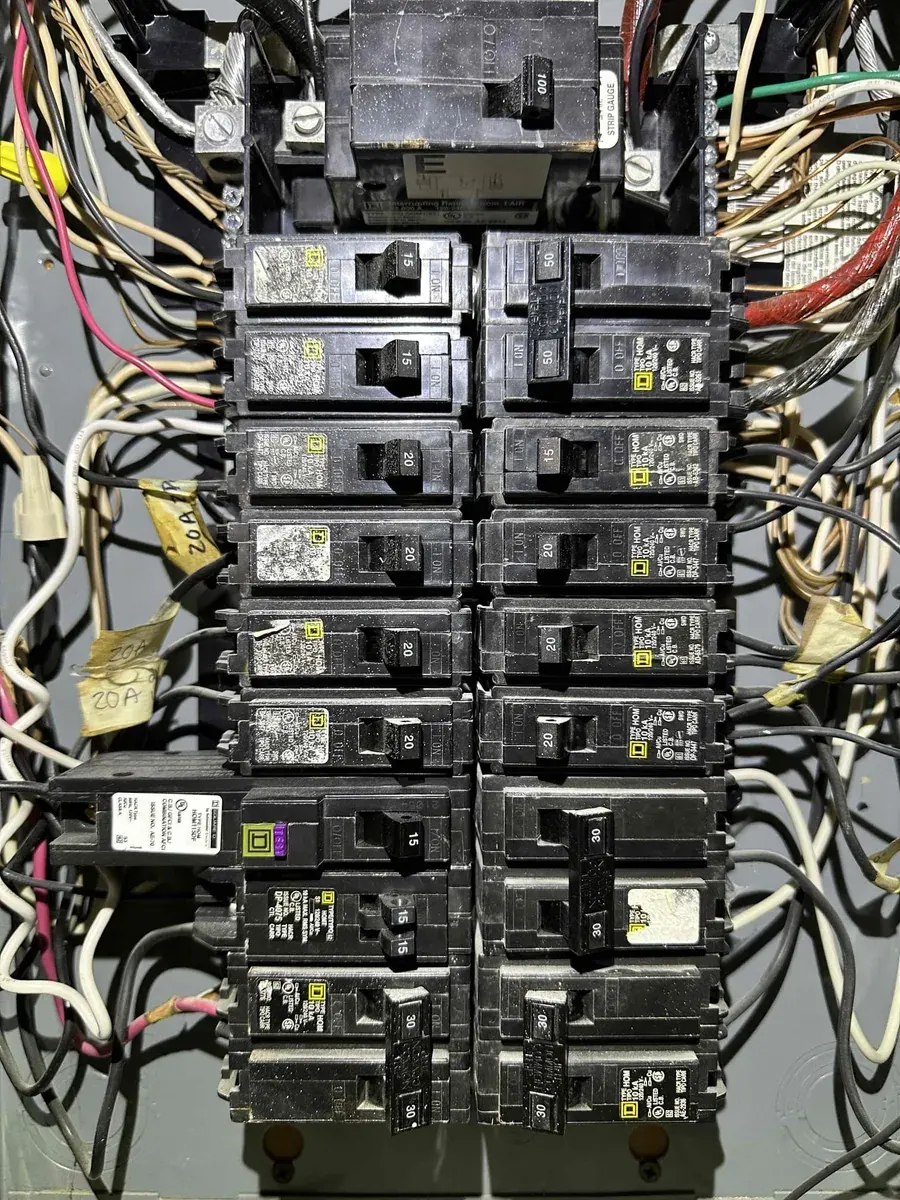
The National Fire Protection Association's data is specific: 32% of electrical fires originate with the insulation wrapped around the conductor, not at the panel, not at the outlet, but inside the wire itself. The only reliable way to interrupt that process is to cut power to the conductor the moment arcing begins. That is exactly what an AFCI breaker does. Ohio's building code now requires AFCI protection in all new residential construction. But millions of existing Columbus-area homes were built before that requirement existed, and many have never had their panels upgraded. If your home was built before the early 2000s and still has its original breakers, you are almost certainly running without arc-fault protection. The fix is not complicated, an electrical panel upgrade to install AFCI breakers on the appropriate circuits is a straightforward job for a qualified electrician.
arc fault detection work, illustration in Columbus, OH

AFCI breakers also protect your appliances

Arc-fault breakers are often discussed purely as a fire-prevention measure, and that's accurate. But there's a secondary benefit worth knowing: because AFCI breakers catch low-level arcing that would otherwise go undetected, they also reduce the cumulative electrical stress that shortens the lifespan of appliances and electronics. A refrigerator, a washing machine, or a home theater system connected to a circuit with intermittent arcing will wear faster than one on a stable, protected circuit. Pairing AFCI breakers with whole-home surge protection gives you a layered defense, one that catches arc events on the circuit level, and one that blocks voltage spikes coming in from outside. Together, they're the most complete electrical protection a residential home can have.

Who requires and endorses AFCI protection

Arc-fault circuit interrupters are not a product recommendation. They are a code requirement backed by national fire safety authorities.

National Fire Protection Association

The NFPA's research into residential electrical fires directly drove the inclusion of AFCI requirements in the National Electrical Code. Their data on insulation fires is the statistical foundation for the mandate.

National Electrical Code (NEC)

The NEC requires AFCI protection in bedrooms, living rooms, hallways, and most other habitable spaces in new residential construction. Ohio adopts the NEC with periodic updates.

Ohio Building Code

New construction in Ohio must comply with current AFCI requirements. Existing homes are not automatically grandfathered if major electrical work is performed, upgrades may trigger code compliance for affected circuits.

Is your Columbus home protected?

If your home was built or last rewired before the early 2000s, it almost certainly does not have AFCI breakers. A panel inspection takes less than an hour and tells you exactly where you stand. Safe Electric & Plumbing has been doing this work in Columbus since 1994. Call (614) 267-4111 to schedule.

Call (614) 267-4111
overload protection work, illustration in Columbus, OH

Recent posts on electrical safety

More from the Safe Electric & Plumbing blog.